This week begins the December Book Reviews feature. For the next three weeks around six books will be reviewed each Friday in the lead to Christmas. This week a diverse selection from the US, Australia, the Arctic Circle, Bangladesh and Syria - Norma I. Quintana - Circus: A Traveling Life ; Evgenia Arbugaeva - Tiksi ; Issa Touma – Women We Have Not Lost Yet ; Berylouise Mitchell - The Birdsville Cup ; Khaled Hasan - Leave Me Alone ; and Ron Haviv - The Lost Rolls .
Book Reviews:
Norma I. Quintana ? Circus: A Traveling Life

My deep love of records and curiosity about the world are the two fundamentals that hold to attract me to documentary images. In modern day world photography is so many things to so many people, however for me it's miles a wealthy supply of facts, a manner to analyze the manner others stay, a conduit for insight, an possibility for compassion and expertise. It is likewise a magic carpet on which to experience into the unknown and return with new understanding and a more appreciation for the larger global.
Long-time period documentary research are the stories that surely engage me, particularly in present day fast-paced global where all of us is in a rush to the finish, ensuing in lots of memories being half-baked. I see a host of work produced each 12 months, plenty of which jogs my memory of an underdone dish - all of the substances are there, but in the frantic desire to get the plate at the table, a few elements are left raw, or now not included, leaving the diner less than satisfied and disenchanted because they realize it can be a lot higher with a little extra time and endurance.
Norma I. Quintana's Circus: A Traveling Life is a beautifully prepared dish, created over a decade. Her commitment to the story of this one-ring travelling circus has resulted in a rich, multi-layered insight into a world few of us can imagine, and even fewer will ever live.
On the surface Circus is a story of a tight knit community dedicated to its craft and a way of life that is becoming less sustainable in the digital age. Yet it is a story that goes so much deeper and that’s the appeal for me. In Circus Quintana’s photographs gently reveal the bonds between performers and the admiration of parents and children for the other’s talents as well as the drudgery of the daily grind, and the euphoria of performance. It is a complete picture that can only have been told over an extended period of time.


Photographed in black and white, on film using only available light, Circus is incredibly satisfying as a documentary body of work. Quintana combines more formal portraiture as well as casual behind-the-scenes moments showing the performers as artists as well as everyday people. This is not a story that could have been shot by dropping in for a couple of weeks and then disappearing.
Other reviewers have as compared Quintana's work to the likes of Diane Arbus, Bruce Davidson and Mary Ellen Mark and whilst those comparisons are obvious, Quintana additionally has a strong voice of her personal, a visible signature that conveys the intimacy and consider she earned along with her subjects. This is one of the genuine advantages of long time work; the opportunity to certainly get to realize the ones you're photographing, for it is through mutual admire and the sharing of lives that the heart of a story can be discovered.


? All pictures Norma I Quintana
Circus: A Traveling Life
Evgenia Arbugaeva ? Tiksi 
?Once upon a time in Siberia, on the beaches of the Arctic Ocean, in a heat mattress in a small town, a touch lady awoke from a dream. It was morning, however it was still dark out, for the little town became up to now north that the solar might no longer display itself for plenty months. They called this the Polar Night?The metropolis was known as Tiksi??
Evgenia Arbugaeva was born in Tiksi, a Yakutian sea port in the Russian Arctic. Her family moved away when she was young, but as an adult she returned in 2010 to once again walk the frozen tundra. In Tiksi she recreates many of the scenes from her childhood, as well as capturing the lives of those who still reside in the remote community with its breathtaking landscape.


Arbugaeva?S paintings first came to my attention in advance this 12 months with her series Weatherman. I have lengthy been drawn to photos and documentaries of the Arctic, a international so foreign to an Antipodean. The ethereal colors of the icy waters, the full-size whiteness, the stark cold, the months of darkness all hold fascination. This book is pleasurable on many levels and is a visual deal with.


? All photographs Evgenia Arbugaeva
Publisher: The Eyes
Issa Touma ? Women We Have Not Lost Yet 
I met up with Syrian photographer Issa Touma at Paris Photo and bought his book Women We Have Not Lost Yet. This book features portraits of young Syrian women dressed in their daily clothes – modern, young women wearing make up, fashionable clothing, and jewellery. I really like the design of this book. Each portrait is split in two, with the picture divided at the eyes – we never see the women’s eyes. Rather we see the top of their heads above the eyebrows, or from the middle of their nose down. Without the eyes to draw focus you really have to look to see. The part portraits are presented in oversized A4 format, the top of one page featuring the first portrait of eyebrows to top of head, running across the top of the page, the remainder left crisp white. On the next page there is a strip of white across the top of the page that signifies the division of the portrait, and also points to an unwritten future.
Each portrait comes with a quick story in the phrases of the sitter, which makes the ebook even more applicable and gives a unique insight into the mind and resolve of these young ladies inside the face of adversity.


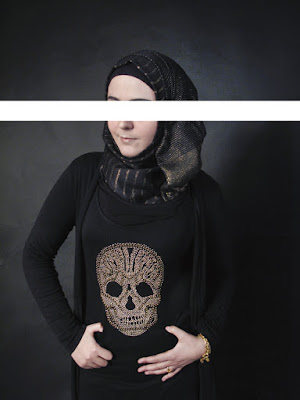

? All pics Issa Touma
This series changed into shot throughout the week of the ?Great Attack? In Aleppo on 26 April, 2015. In that week these younger ladies, of various ethnicities and spiritual backgrounds, sought safe haven in Touma?S Le Pont Gallery. The majority were former individuals of Art Camping, a collaborative challenge Touma began in 2012 in response to the outbreak of the Syrian struggle. Touma believes that ?Art is essential for surviving the horrors of battle and retaining the ideas of an inclusive society which can be threatened through political and religious fanaticism. This book documents the photograph periods held at Le Pont at some stage in the week of the Great Attack. It is a cry for freedom from the girls that Syrian society has no longer misplaced but ? To dying, exile or oppression?.
In 1996 Touma began Le Pont Gallery and the subsequent year the International Photography Festival Aleppo. You also can view an interview with Issa Touma - Postcards from Syria
Publisher: Paradox & André Frère Éditions
Berylouise Mitchell - The Birdsville Cup 
Most Australians are familiar with the Birdsville Cup, which is oft referred to as the ‘Melbourne Cup of the Outback’. This two day racing carnival held annually in September in the remote outback town of Birdsville in Queensland - a mere 3200 kilometres west of Brisbane, literally in the middle of nowhere near the intersection of the Queensland, NSW and Northern Territory borders - has long held fascination for Australians, especially those city slickers who romanticise the outback and its stories, but Birdsville has one of the harshest climates on the planet. Its permanent population of around 120 swells to nearly 7000 when the Cup is on with visitors pitching tents, sleeping in vans and under the wings of light aircraft as there isn't any accommodation for rent.
As a student, photographer Berylouise Mitchell documented every aspect of the race. That was 25 years ago. To mark this anniversary she has published a book through crowd funding - The Birdsville Cup - donating 100 copies to the Birdsville community to raise funds for the Royal Flying Doctor Service, which is an essential service for those living remotely.


These black and white photographs are an important historical record and the story they tell is worth knowing. In the book Mitchell also makes special mention, in words and pictures, of the small towns she passed through on her way to Birdsville including Quilpie, Windorah and Betoota and the characters she met. Mitchell’s journey took her through some of the most remote towns in Australia and her gritty black and white images convey the isolation, dust and heat that is ever present. This is a unique slice of Australian history.


© All images Berylouise Mitchell
The Birdsville Cup
Khaled Hasan – Leave Me Alone 
Shot in Bangladesh over a three-year period (2010-2013), Khaled Hasan’s documentation of the victims of acid attacks - Leave Me Alone - is not an easy book to view, but it tells an important and unfortunately a common story among those who live in the rural provinces of Bangladesh. Many of the victims of acid attacks are young women who are left disfigured and often blind, their opportunity for a ‘normal’ life stolen – in the majority of attacks acid is thrown in the woman’s face leaving permanent damage. But it is not only women who suffer. Men are also victims of acid attacks.


© All images Khaled Hasan
In Bangladesh there are scant medical or social resources to deal with those who are burned and maimed with many left to live with horrendous pain and emotional and physical scarring. Yet Hasan's book is not just about the victims, but about the human spirit and the strength of those pictured to forge ahead with the hope for a better life.
Published by KAUNAS PHOTO.
Ron Haviv - The Lost Rolls 
VII co-founder and award-winning photojournalist Ron Haviv was also in Paris to launch his new book and magazine ‘The Lost Rolls’, which literally features photographs that Ron re-discovered when he found around 200 rolls of film he hadn’t processed. “There might be even more,” he smiles.
Of the 200 a number were blank, and some had only one frame worthwhile using. In the end there were about 140 rolls that were usable. Robert Peacock and Ron edited the photographs together basing the selection process on “the story behind the photograph, or lack of, and the actual photograph itself. Some had varying degrees of degradation and became more than what they were originally also,” Ron explains.


He says it was quite fascinating rediscovering images or finding other versions of photographs that had been published years ago and were quite well known. “There are also images here that I don’t know where I was, or who the people are or why I was photographing them. While that’s interesting in terms of a sense of mystery, it’s also disconcerting. And then there are images that I remember taking but never saw or couldn’t find. Some of those memories and adventures are now more complete. But I’ve also now created all sorts of other incomplete scenarios and I really now want to know what those images are”.


© All images Ron Haviv
This is Ron’s fourth book and his first self-publishing venture. He says nowadays it is a more complicated process to find a traditional publisher to take on a project and often that involves the photographer coming up with a substantial amount of money, usually around $25-30,000. With this project there was the additional cost of developing the film also. Ron teamed up with Blurb to produce ‘The Lost Rolls’ in a venture that helped both parties; it allowed Blurb to showcase its new technologies and Ron to develop the film and have control of the distribution and marketing.
“The stigma that existed with self-publishing even three or four years ago is no longer realistic. Distribution now is pretty easy, it’s been democratised and that was one of the reasons you’d go to a traditional publisher. The second would be the public relations around the book. Having done traditional publishing I’ve found they’re often terrible at that. So what’s the difference? It’s distribution and PR. So if you can do that as a photographer your book is going to be successful.”
The quality of the book is impressive, and Ron tells that it is printed offset, not digitally printed on demand. That’s an exciting development, making offset printing more affordable for self-publishers and raising the quality available. Blurb also offers warehousing and orders are made directly. The photographer chooses the production price and their mark up and Blurb manages the whole process. It doesn’t get any easier than that. PR is up to the photographer and as many today have large social media networks, getting the message out is relatively straightforward.
Ron chose to print around 1500 copies of ‘The Lost Rolls’ hardcover book. Given it was a Blurb project, Ron also had the opportunity to produce a magazine so Blurb could show off the other technologies available to photographers. “The magazine is really exciting, probably even more exciting than the books because it is obviously less expensive to produce and you have the ability to do a magazine of any size”.
“In differentiation to the book, we approached the Lost Rolls magazine more as an editorial – text on photographs, captions with the images. It was a cool way to do something different.”
Ron says the magazine concept opens up a whole lot of opportunities. VII is planning to produce a series of magazines. In fact this weekend just past, Ron and VII photographer Ashley Gilbertson presented at a conference in Boston and had available a VII magazine featuring the refugee work the agency’s photographers have done recently. “People want to have something in their hand. It’s great to have the iPad, but people still – not the masses but enough of an audience – want to flip through a magazine, they want to have something tangible”.
‘The Lost Rolls’ has both a French and English version, with different covers. Ron says that’s another benefit of self-publishing with Blurb, the ability to on the fly upload a new PDF of the book and adapt it for various markets.

Ron in Paris October 2015 © Alison Stieven-Taylor
“Blurb is a very smart company and Eileen (Gittins the founder) is quite brilliant in what she’s done,” Ron says. “I think this is my best book.”
The Lost Rolls


_1200pxl.jpg&container=blogger&gadget=a&rewriteMime=image%2F*)
(Contre-jour%252C-1961)_1200pxl.jpg&container=blogger&gadget=a&rewriteMime=image%2F*)
_1200pxl.jpg&container=blogger&gadget=a&rewriteMime=image%2F*)


